Executive takeaway
Give every enquiry an owner and an achievable next step.
AI can help staff draft, summarise and organise. The business must verify offers, confirm bookings and measure completed outcomes.
The campaign earned attention. Who owns the next step?
A makeover Reel gets shared. WhatsApp fills with “Price?” and “Available this weekend?” The campaign report looks encouraging. Yet the appointment book barely changes.
Before buying more reach, follow a few enquiries through the whole journey. Was the offer clear? Did the reply answer the question? Could staff confirm availability? Did someone own the follow-up? Was the eventual visit connected to the enquiry?
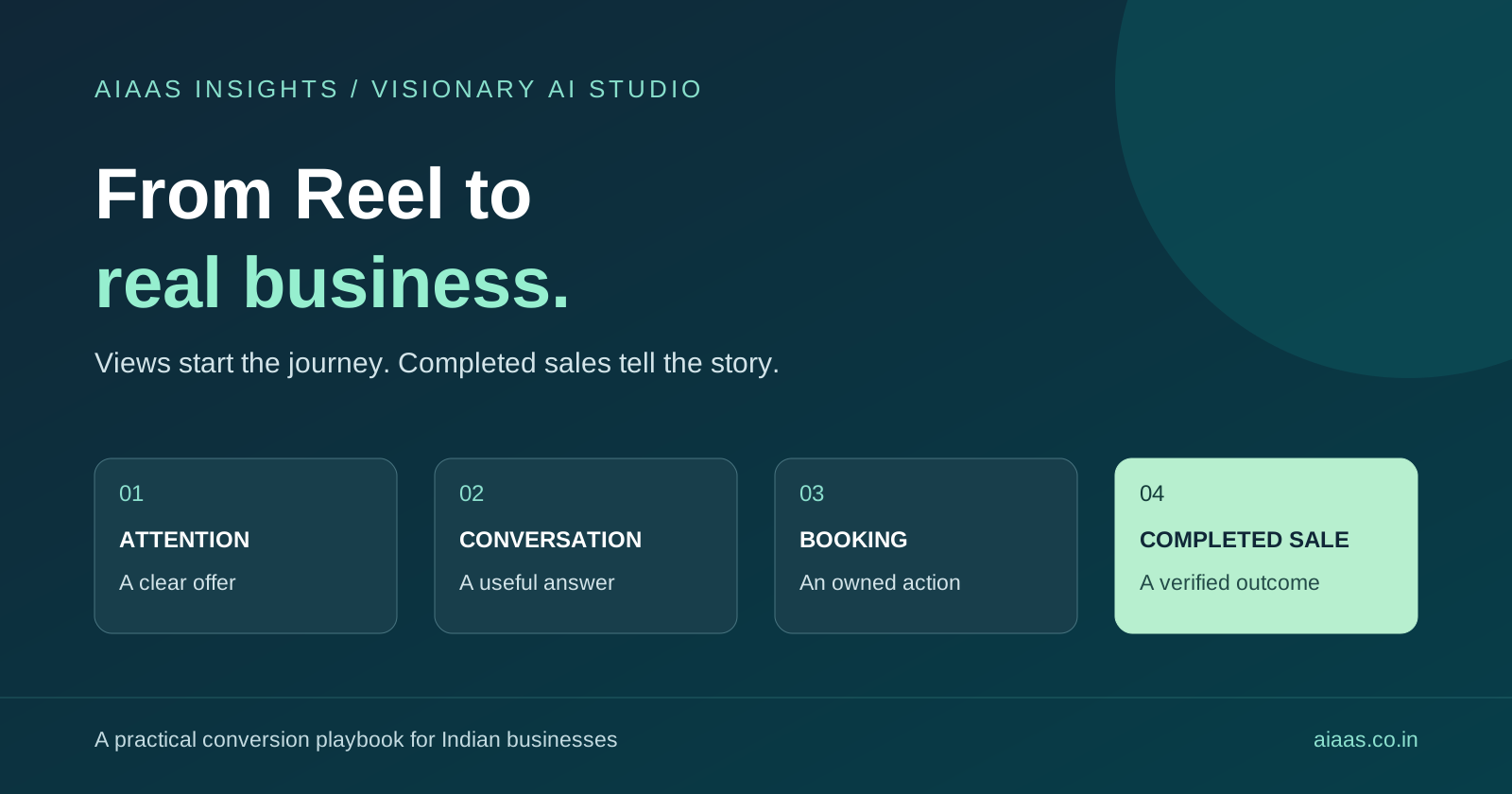
A view, a conversation, a booking and a completed sale are different events. Improving one does not automatically improve the next. Connect them through a small, accountable workflow before adding automation.
Discovery and buying are becoming a connected journey
Meta’s May 2026 India update describes shopping shaped by short videos, creators and business messaging. Its February publication with the Retailers Association of India also examines journeys spanning social discovery, conversations and physical stores. [1] [2]
These are platform-published accounts of research and commercial examples. They provide context, not a forecast for your salon or a guarantee that messaging causes sales. We do not use the reported performance lifts as targets below.
Our practical inference: evaluate the transitions between channels. Content and customer communication should share an offer, an accountable owner and a definition of a completed outcome.
One Reel, one offer, one complete customer journey
Illustrative example: a fictional Kolkata salon promotes a haircut-and-styling package. The team has an approved price list, service inclusions, address, booking calendar and cancellation terms. None of the numbers or conversations below are client results.
| Stage | Common gap | Practical repair |
|---|---|---|
| Discover | A striking Reel hides the actual offer. | State the service, location, price conditions and next action. Use a campaign code or tagged link. |
| Understand | Every enquiry gets the same brochure. | Answer from approved facts, then ask only what helps: service, branch and preferred day. |
| Book | “We will get back to you” ends the exchange. | Assign reception to verify the calendar and offer a real slot. Separate pending from confirmed. |
| Follow up | Messages wait without an owner. | Record the next action and agreed update time. Respect preferences and stop when the customer declines. |
| Complete | A booking is counted as revenue. | Record attendance and the actual paid service; show cancellations and refunds separately. |
A campaign label helps connect records, but cannot prove that an ad caused the sale. Customers may have seen several posts, heard from a friend or visited before. Keep “unknown” available rather than forcing attribution.
Answer first. Qualify briefly. Confirm with evidence.
For this fictional exchange, the approved package is ₹1,200 including applicable taxes, covers haircut and styling, and excludes colour. The appointment becomes confirmed only after staff verify and save it.
Customer: “Saw your Reel. What is the price?”
Salon: “The haircut-and-styling package shown is ₹1,200, including applicable taxes. Colour is separate. Are you looking at our Kolkata branch, and which day would suit you?”
Customer: “Saturday afternoon. Can I come at 4?”
Salon: “I’ll ask reception to check Saturday at 4 pm. It is not booked yet. May we update you here about this appointment?”
Customer: “Yes.”
Reception, after verifying and saving the booking: “Your appointment is confirmed for Saturday [exact date] at 4 pm at [branch address], reference [booking ID]. The package and total are as above. Here are our booking terms: [approved link]. Please tell us here if you need to change it.”
Replace every placeholder and verify each commitment before sending. If a slot is unavailable, offer verified alternatives. A requested time is not a reservation. An enquiry is not an invitation to send unrelated promotions.
Offer English, Hindi or Bengali when staff can support the conversation accurately. Review translated service names, price conditions and dates; fluent wording can still be wrong.
Give AI a bounded job and staff a clear responsibility
- Draft: turn approved service information into a relevant answer for staff review.
- Summarise: capture the requested service, preferred time and unresolved question.
- Organise: flag enquiries with no owner or an overdue next action.
- Review: identify recurring questions and unclear campaign wording.
People remain responsible for prices, discounts, availability and exceptions. Live booking requires a tested integration with appropriate access and a verified result. Without it, AI should prepare a request for staff, not claim it changed the calendar.
Use approved tools and the minimum customer data needed. Keep the tracker access-controlled. Check the current requirements for the WhatsApp product you use before automating outbound messages.
Before the next Reel goes live
- The offer matches the current price list and chat information.
- The customer can identify the location, service and important conditions.
- The link opens the intended business conversation with a useful source label.
- Staff answer from one approved reference.
- Each enquiry has one owner and a recorded next action.
- Customers can reach a person, with honest staffed hours.
- Pending requests, confirmed bookings and completed sales have distinct statuses.
- Follow-up preferences, declines and stop requests are respected.
- Attendance, collected revenue, refunds and cancellations reach the reporting process.
- The weekly review examines lost enquiries as well as successful conversations.
Test a normal enquiry, an unclear question, an out-of-hours request and an unavailable slot. Check that each receives an accurate, achievable next step.
One row per enquiry. Evidence for each outcome.
Copy these fields into an approved internal spreadsheet or CRM. Use an internal enquiry reference instead of phone numbers in marketing reports. Keep necessary contact information in your restricted customer system.
Enquiry reference | Received date | Campaign/source (or unknown)
Service | Owner | Status | Next action | Due date
Follow-up preference | Booking reference | Appointment date
Attended? | Completed sale? | Net collected revenue | Lost reason
Suggested statuses: new, awaiting customer, awaiting staff, confirmed, completed, cancelled and closed without sale. Deduplicate repeat messages about the same request. Define a reporting cohort and allow its appointments to occur before judging conversion.
| Measure | Calculation or check |
|---|---|
| Useful response time | Time until an answer addresses the question. Separate staffed and out-of-hours enquiries. |
| Enquiry-to-booking rate | Unique enquiries producing a confirmed booking ÷ unique enquiries in the same cohort. |
| Attendance rate | Attended appointments ÷ confirmed appointments due. Report cancellations and reschedules separately. |
| Enquiry-to-sale rate | Unique enquiries producing a completed paid service ÷ unique enquiries in a mature cohort. |
| Campaign cost per acquired customer | Defined campaign costs ÷ verified new customers attributed under your stated method. |
Worked example: a fictional campaign costs ₹6,000 and produces 100 unique enquiries, 30 confirmed bookings and 24 completed paid appointments. Enquiry-to-booking is 30%; enquiry-to-sale is 24%. If all 30 bookings were due and none rescheduled, attendance is 80%. Campaign spend per completed appointment is ₹250.
That ₹250 is not automatically customer acquisition cost: some visitors may be existing customers. It excludes any creative, staff or software costs omitted from the ₹6,000. Include those for a fuller business view. Revenue is not profit; these figures are arithmetic illustrations, not benchmarks.
Fix one transition before scaling
Start with one service, one location and a manageable enquiry volume. Record a baseline, then repair one weakness: a vague offer, unanswered price questions or booking handovers without an owner.
For two weeks, review pending enquiries daily. After appointments are due, examine completed outcomes and lost reasons. Small samples reveal operational gaps but do not establish reliable causal improvement. Compare similar sources and service types, use concurrent comparison groups where practical, and record changes in discounts, staffing or seasonality.
At the next campaign meeting, ask: “Which step prevented an interested customer from completing the next action?” Answer from actual records before asking AI to send more messages.
Sources and editorial notes
- Meta: From Scroll to Chat to Cart — 13 May 2026; platform perspective on discovery, short video and messaging in India.
- Meta and Retailers Association of India: omnichannel shopping whitepaper announcement — 24 February 2026, updated 25 February; research findings and retailer examples reported by Meta.
Sources checked 26 October 2026. The salon, conversation and arithmetic are fictional teaching examples. The workflow, checklist and tracker are Visionary AI Studio’s proposed framework, not promised results. Prepared with AI assistance. Test outcomes in your own business.